


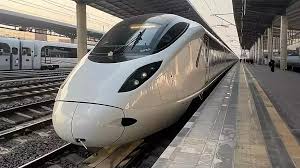
Pakistan Railways has announced ambitious plans to launch the country’s first-ever bullet train service, aimed at slashing travel time between Lahore and Karachi from nearly 20 hours to just five hours by 2030.
The project, which falls under the $6.8 billion Main Line-1 (ML-1) upgrade of the China-Pakistan Economic Corridor (CPEC), is being hailed as the most transformative transport initiative in Pakistan’s history.
A Modern Alternative to Air Travel
Railways Minister Hanif Abbasi, who unveiled the plan earlier this year, said the bullet train will not only modernize Pakistan’s century-old railway infrastructure but also provide a cheaper and faster alternative to domestic air travel.
The project will be developed in collaboration with Chinese companies, including the China Railway Construction Corporation.
Operating along a 1,215-kilometre route from Karachi to Lahore, the train will make major stops in Hyderabad, Multan, and Sahiwal. Designed for speeds of up to 250 km/h, the service is expected to reduce travel time from the current 18–22 hours (on express trains such as the Green Line) to just five hours.
Ticket prices are projected to fall between PKR 5,000 and 10,000 for economy and business class—significantly lower than average airfare (PKR 20,000–30,000)—making it an affordable option for students, professionals, and families.
ML-1 Upgrade and Expansion Plans
The broader ML-1 project includes:
- Laying of double tracks across the route.
- Rebuilding old railway bridges.
- Installation of modern signalling systems.
- Increasing maximum speeds from the current 60–105 km/h to high-speed rail standards.
In addition, Punjab Chief Minister Maryam Nawaz Sharif has already approved the Lahore–Rawalpindi bullet train project, expected to cut travel time between the two cities to just 2.5 hours, compared to the current four to five hours.
Project Timeline
- Feasibility Study: Completed in June 2025
- Construction Start: 2026
- Testing Phase: 2029
- Launch: 2030 (with 10–15 daily trips planned)
Economic Impact and Job Creation
Officials estimate the bullet train will generate thousands of jobs during both construction and operation phases. By reducing reliance on costly road transport, it is also expected to save billions in fuel imports, while boosting Pakistan’s freight rail share from 4% to 20% by 2030.
The new system is projected to connect Pakistan’s economic hubs of Karachi and Lahore, strengthening trade flows and potentially linking in the future to the proposed Kashgar–Karachi rail line under CPEC, enhancing Pakistan’s role in regional commerce.
A Transformative Step for Pakistan
“This project is not just about reducing travel time,” said Minister Abbasi. “It is about reshaping Pakistan’s economy, creating opportunities, and connecting people like never before.”
With its launch, the Lahore–Karachi bullet train is expected to redefine travel in Pakistan—offering an affordable, high-speed, and modern alternative to existing transport modes, while reinforcing the country’s long-term vision of sustainable economic growth.
Tags:
Subscribe To Get Update Latest Blog Post
No Credit Card Required


