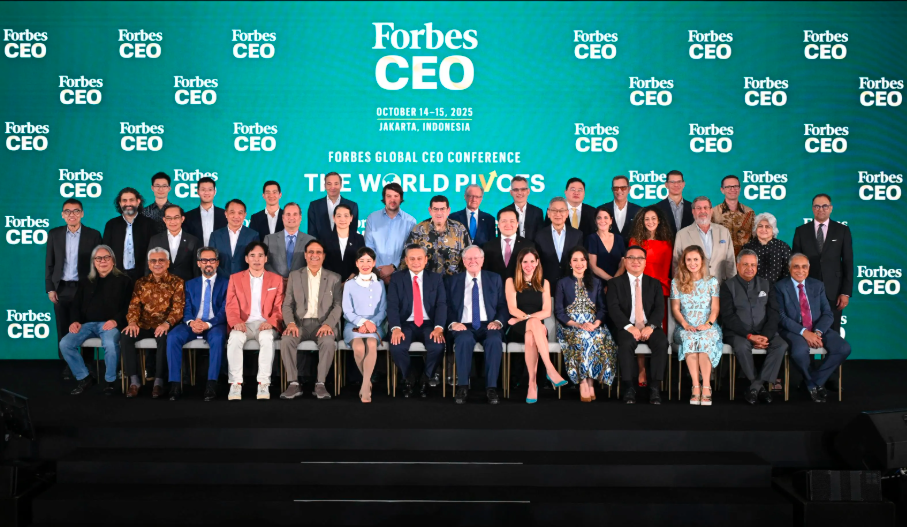
The 23rd Forbes Global CEO Conference took place in Jakarta, Indonesia, on October 14 and 15, convening leading CEOs, thought leaders, entrepreneurs and investors from around the world to discuss key issues of global concern and to build new partnerships.
Notable speakers at the event included: Steve Forbes, Chairman and Editor-in-Chief, Forbes Media; Prabowo Subianto, President of the Republic of Indonesia; Rosan Perkasa Roeslani, Minister, Investment and Downstream Industry, Chairman, Indonesia Investment Coordinating Board (BKPM) and CEO of Danantara Indonesia; Tadashi Yanai, Chairman, President and CEO of Fast Retailing; Chartsiri Sophonpanich, President of Bangkok Bank; Anthony Capuano, President and CEO of Marriott International; Tony Fernandes, CEO of Capital A; Koh Boon Hwee, Chairman of Altara Ventures and Chairman of Singapore Exchange Group; Jane Sun, CEO of Trip.com Group; Joseph E. Aoun, President of Northeastern University; Anthony Tan, CEO, Cofounder and Chairman of Grab; and Pandu Patria Sjahrir, Chief Investment Officer of Danantara Indonesia.
For the full list of speakers, please visit the conference website. Key insights and highlights from the conference can be found below.
A Meeting of Minds: A conversation between Prabowo Subianto, President, Republic of Indonesia and Steve Forbes, Chairman and Editor-in-Chief, Forbes Media

Prabowo Subianto (left), President of the Republic of Indonesia, in conversation with Steve Forbes (right), Chairman and Editor-in-Chief of Forbes Media, at the Forbes Global CEO Conference 2025.
Forbes Asia
Indonesian President Prabowo Subianto expressed confidence that Indonesia can meet his ambitious target of annual GDP growth of 8%, helped by spending on a nationwide program to provide free, nutritious meals to school children and pregnant women.
“I think 8% is very achievable,” Prabowo said in a conversation with Steve Forbes, chairman and editor-in-chief of Forbes Media, at the Forbes Global CEO Conference in Jakarta.
Every $1 spent on the free meal program, Prabowo said, would result in returns of between $5 to $7: “My first purpose is to overcome the hunger of children.”
He said that the nationwide program to provide free meals to school children, for which the government has earmarked 335 trillion rupiah ($20 billion), could provide a big boost to the economy. The program aims to feed about 83 million school children daily and could potentially create 1.5 million jobs.
Malcolm S. Forbes Lifetime Achievement Award

Tadashi Yanai (left), Chairman, President and CEO of Fast Retailing, is awarded the Malcolm S. Forbes Lifetime Achievement Award by Steve Forbes (right) at the Forbes Global CEO Conference 2025.
Forbes Asia
Uniqlo’s Billionaire Founder Tadashi Yanai Receives The Malcolm S. Forbes Lifetime Achievement Award
Tadashi Yanai, chairman, president and CEO of Japanese clothing giant Fast Retailing, received the Malcolm S. Forbes Lifetime Achievement Award at the Forbes Global CEO Conference 2025 in Jakarta.
The award recognizes a lifetime of achievement and is a celebration of the global business success bestowed upon an individual who embodies and exemplifies the ideals of entrepreneurship championed by the late Malcolm S. Forbes, the legendary publisher of Forbes.
“Over his remarkable career, Tadashi Yanai reshaped global apparel and redefined how clothing companies operate,” said Steve Forbes, chairman and editor-in-chief of Forbes Media, as he presented the award to Yanai. “From a single menswear shop in Japan, he built Fast Retailing, parent of clothing brand Uniqlo, into one of the world’s leading apparel retailers, known for its simplicity, quality and affordability.”
“It is a great honor and pride for me to receive the Malcolm S. Forbes Lifetime Achievement Award,” Yanai, 76, said. “It has been the symbol of success in the global business world.”
In Conversation with Rosan Perkasa Roeslani, Minister, Investment and Downstream Industry, Chairman, Indonesia Investment Coordinating Board (BKPM), CEO, Danantara Indonesia

Rosan Perkasa Roeslani (left), Minister, Investment and Downstream Industry, Chairman, Indonesia Investment Coordinating Board (BKPM), CEO, Danantara Indonesia, in conversation with Rich Karlgaard (right), Futurist and Columnist at Forbes Asia, at the Forbes Global CEO Conference 2025.
Forbes Asia
Rosan Perkasa Roeslani shared his plan to undertake the rationalization of Danantara Indonesia’s more than 1,000 state-owned enterprises to 200. “The goal is to improve efficiency and enhance economic growth,” Roeslani said at the Forbes Global CEO Conference in Jakarta.
SOEs account for up to 50% of the country’s GDP and restructuring this sector would have a significant socio-economic impact across the archipelago, he added.
The government also plans to tap AI and robotics to boost productivity, while at the same time upskilling Indonesia’s abundant pool of young workers with a median age of 30 years.
Fact & Comment by Steve Forbes, Chairman and Editor-in-Chief, Forbes Media

In his Fact & Comment speech, Steve Forbes shared his thoughts on the tariffs announced by U.S. President Donald Trump, stating that, “Tariffs are like a wedge between producers and consumers.” He added that they would hurt margins, productivity and economic advancement, apart from creating uncertainty.
While the U.S. government has argued that higher tariffs are needed to tackle the country’s trade deficit, Forbes said a swathe of government regulations have hurt American industry far more. “The one thing that the Trump administration is doing, even though it’s unglamorous, is removing a lot of these regulations.”
He cautioned that rising global debt—combined private sector and government borrowings are at an all-time high of $320 trillion—is also a major threat to the global economy. “When you have rapid growth, debt becomes something you can easily handle,” he said. “But in a low-growth environment, it is just asking for trouble.”
Panel: New Directions For Global Economy

(L-R) Anindya N Bakrie, Chairman, Indonesia Chamber of Commerce and Industry (Kadin), CEO, Bakrie & Brothers; Ho Kwon Ping, Founder and Executive Chairman, Banyan Tree Holdings; John A. Quelch, American President and Executive Vice Chancellor, Duke Kunshan University; and George Raymond Zage III, Founder and CEO, Tiga Investments at the Forbes Global CEO Conference 2025. Moderated by Rana Wehbe Watson (far right), Editorial Director, Forbes Asia.
Forbes Asia
Forbes Global CEO Conference 2025: Trade Alliances Get Reset As U.S. Tariffs Drive Uncertainties
“Indonesia’s GDP growth target of 8% is possible, but we need time and partners to get there,” said Anindya N Bakrie, Chairman of Indonesia Chamber of Commerce and Industry (Kadin) and CEO of Bakrie & Brothers.
“The U.S. and China are diametrically opposite, but quite effective in their own ways in terms of being able to resolve problems relatively fast,” said Ho Kwon Ping, Founder and Executive Chairman of Banyan Tree Holdings.
“China is doing an excellent job of pivoting to the rest of the world. There is a rebalancing that could be beneficial to the global economy,” said John A. Quelch, American President and Executive Vice Chancellor of Duke Kunshan University.
“The one thing that is predictable about the Trump administration is that they’ve taken an incredibly pro-business view,” said George Raymond Zage III, Founder and CEO of Tiga Investments.
Panel: Real Estate Gets Real

(L-R): Anthony Capuano, President and CEO, Marriott International; Lee Yeow Chor, Group Managing Director and CEO, IOI Corporation; Irfan Razack, Chairman and Managing Director, Prestige Group; Panote Sirivadhanabhakdi, Group CEO, Frasers Property; and Michael T. Smith, Chief Executive, Hongkong Land at the Forbes Global CEO Conference 2025. Moderated by Luisa Kroll (far right), Executive Editor, Forbes Media.
Forbes Asia
Forbes Global CEO Conference 2025: Real Estate Leaders Unpack Asia’s Property Trends
“As AI becomes more advanced, the unique challenge for us is to remind ourselves that we are a human connection business,” said Anthony Capuano, President and CEO of Marriott International.
“If you want to encourage people to use less cars, you have to make sure there are enough neighborhood conveniences so that people don’t need to drive a car,” said Lee Yeow Chor, Group Managing Director and CEO of IOI Corporation.
“The only way you can build a credible brand is by sheer delivery. We made sure whatever we committed, we can deliver,” said Irfan Razack, Chairman and Managing Director of Prestige Group.
“As we grow in the ASEAN region, we want to grow with partnerships so that we can grow with sustainability and be resilient,” said Panote Sirivadhanabhakdi, Group CEO of Frasers Property.
“We want to create an ecosystem where people want to work, live and play. Once you create that, it’s quite hard to disrupt,” said Michael T. Smith, Chief Executive of Hongkong Land.
Panel: The Art Of Growth Leadership

(L-R): Joseph E. Aoun, President, Northeastern University; Yoshito Hori, Founder and President, GLOBIS University, Founding Partner, GLOBIS Capital Partners; Shinta W. Kamdani, Chairman, APINDO, CEO, Sintesa Group; and Jane Sun, CEO, Trip.com Group at the Forbes Global CEO Conference 2025. Moderated by Moira Forbes (far right), Executive Vice President, Forbes Media, President and Publisher, ForbesWomen.
Forbes Asia
“What we are seeing now is the need for lifelong learning. Universities have to start thinking of providing not just education for the 18 to 22, but also lifelong learning opportunities,” said Joseph E. Aoun, President of Northeastern University.
“In order to survive and be successful, you need to be unique. You need freedom in management to be unique and nimble,” said Yoshito Hori, Founder and President of GLOBIS University and Founding Partner of GLOBIS Capital Partners.
“It’s nice to be in a situation where you just say the nice things. But we need to be brave in order to move forward,” said Shinta W. Kamdani, Chairman of APINDO and CEO of Sintesa Group.
“During good times, we try to be very frugal. Then during hard times, that’s the time we can really support the customers while the others withdraw,” said Jane Sun, CEO of Trip.com Group.
Panel: Proven Ideas Face Major Pivots

(L-R): Binod K. Chaudhary, Chairman, Chaudhary Group and CG Corp Global; Mohammed Dewji, President, MeTL Group; Tony Fernandes, CEO, Capital A; and William E. Heinecke, Founder and Chairman, Minor International at the Forbes Global CEO Conference 2025. Moderated by Moira Forbes (far right), Executive Vice President, Forbes Media, President and Publisher, ForbesWomen.
Forbes Asia
“Whenever you see a crisis, there is an opportunity. We’ve always entered markets that were in deep trouble and we ended up doing our best business ever,” said Binod K. Chaudhary, Chairman of Chaudhary Group and CG Corp Global.
“To be able to build a successful business in an economy that’s small is complex. What I did was to follow the money, follow what Africans need day to day,” said Mohammed Dewji, President of MeTL Group.
“You either capitulate or innovate. The key word during a difficult period is resilience,” said Tony Fernandes, CEO of Capital A.
“When you have a crisis, we are forced to reduce people. But you can’t give up. We buckle down and get more money,” said William E. Heinecke, Founder and Chairman of Minor International.
Subscribe To Get Update Latest Blog Post
No Credit Card Required