


The US space agency NASA has announced that it may launch the Artemis II mission earlier than its previously committed timeline of late April 2025. Officials said the launch window could open as soon as February 5, 2025, though they emphasized that safety remains the top priority.
If successful, this will mark the first crewed lunar mission in over 50 years, since Apollo 17 in 1972, sending four astronauts on a historic 10-day journey around the Moon and back.
Artemis II: A Pivotal Step in Lunar Exploration
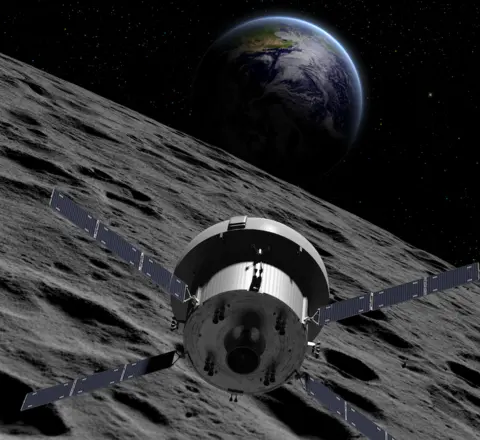
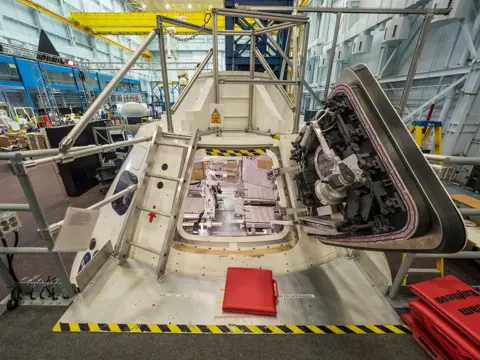
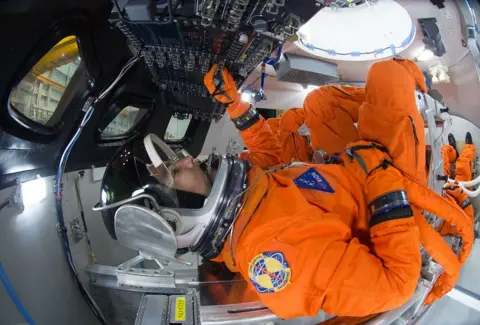
The mission is the second stage of NASA’s Artemis program, which aims to return humans to the Moon and eventually establish a sustainable presence on the lunar surface. While Artemis I in 2022 tested the rocket and spacecraft systems with an uncrewed flight, Artemis II will carry astronauts aboard the Orion capsule to test life-support systems and deep-space operations.
“We together have a front-row seat to history,” said Lakiesha Hawkins, NASA’s acting deputy associate administrator. “The launch window could open as early as February, but safety is our top priority.”
The Crew and Their Journey
The mission will carry four astronauts:
-
Reid Wiseman, Mission Commander (NASA)
-
Victor Glover, Pilot (NASA)
-
Christina Koch, Mission Specialist (NASA)
-
Jeremy Hansen, Mission Specialist (Canadian Space Agency)
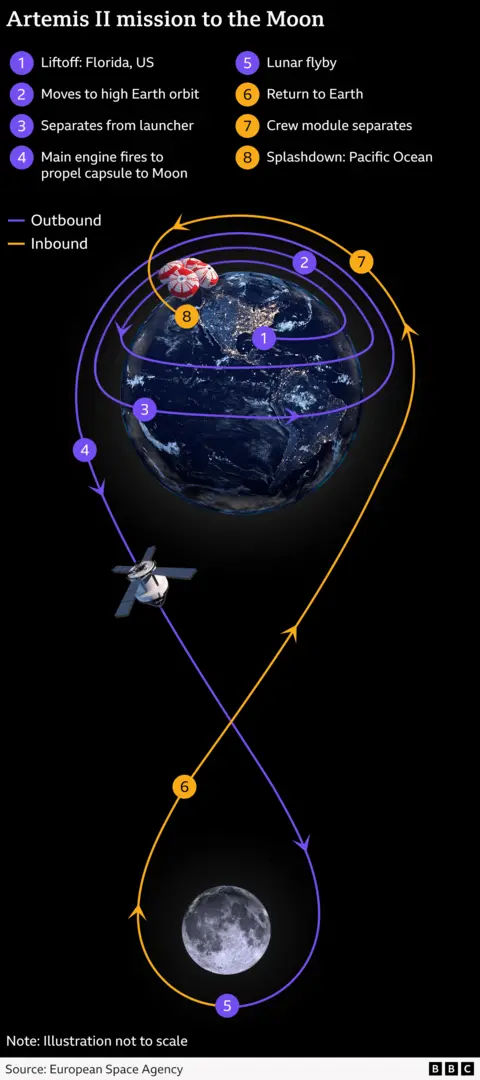
They will not land on the Moon but will travel over 5,000 nautical miles (9,200 km) beyond the lunar surface, the farthest humans have ever ventured into space.
Mission Sequence
-
Liftoff: From Kennedy Space Center aboard the Space Launch System (SLS).
-
Orbit Around Earth: Powered by two solid rocket boosters that detach after two minutes.
-
Separation: The Core Stage detaches eight minutes after launch, leaving the Interim Cryogenic Propulsion System (ICPS) and Orion.
-
System Checks: Orion deploys solar arrays and undergoes full systems testing in Earth orbit.
-
“Space Ballet”: Astronauts manually maneuver Orion near ICPS to rehearse docking procedures for future lunar landings.
-
Translunar Injection (TLI): Orion fires engines to begin a four-day journey toward the Moon.
-
Lunar Flyby: Astronauts slingshot around the Moon, reaching 230,000 miles from Earth.
-
Return Journey: The crew heads home, with Orion’s service module detaching before Earth re-entry.
-
Splashdown: The capsule lands in the Pacific Ocean off the coast of California.
Human and Scientific Experiments
In addition to testing spacecraft systems, astronauts will serve as “human guinea pigs.” Scientists plan to study how space affects the body using organoid samples—miniature tissues grown from the astronauts’ blood—before and after flight.
“We want to study the impact of microgravity and radiation in depth,” explained Dr. Nicky Fox, NASA’s head of science. “We can’t dissect an astronaut, but we can dissect these organoids.”
Challenges Ahead
While Artemis II is expected to pave the way for Artemis III, which aims to land astronauts on the Moon, experts warn that the timeline remains optimistic.
Dr. Simeon Barber of the Open University noted that a mid-2027 lunar landing is “a best-case scenario,” pointing out that SpaceX’s Starship, which will serve as the lunar lander, still faces major hurdles before it can safely transport astronauts.
Looking Forward
For now, NASA’s priority is ensuring Artemis II proceeds smoothly. The mission will be the first step in a new era of human space exploration, one that not only seeks to revisit the Moon but also build a foundation for future Mars missions.
Tags:
Subscribe To Get Update Latest Blog Post
No Credit Card Required


