


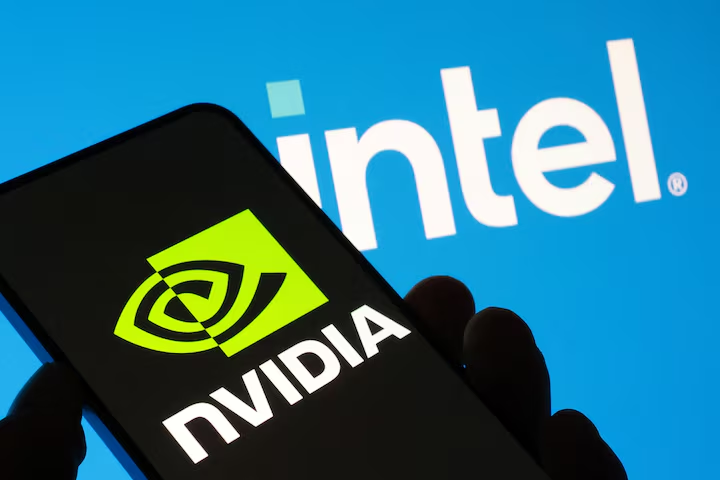
Nvidia (NVDA.O) announced on Thursday that it will invest $5 billion in Intel (INTC.O), throwing crucial support behind the once-dominant U.S. chipmaker. The move comes just weeks after the White House orchestrated an unprecedented deal for the federal government to acquire a large stake in Intel.
The announcement sent Intel’s shares surging by 23%, offering the company fresh momentum after years of failed turnaround efforts. With this stake, Nvidia will own roughly 4% of Intel following the issuance of new shares, making it one of the chipmaker’s biggest shareholders.
A Lifeline for Intel
Intel, once hailed as the pioneer that put the “silicon” in Silicon Valley, has been struggling to regain ground in the global chip race. Earlier this year, the company appointed Lip-Bu Tan as CEO in March. However, his appointment quickly drew criticism from U.S. President Donald Trump over alleged ties with China.
A subsequent high-level meeting in Washington led to an extraordinary arrangement: Intel agreed to hand the U.S. government a 10% stake in the company.
The new investment from Nvidia, coupled with previous backing from SoftBank ($2 billion) and the U.S. government ($5.7 billion), significantly boosts Intel’s capital reserves at a critical time.
Nvidia Steps In With Strategic Collaboration
Speaking to reporters, Nvidia CEO Jensen Huang clarified that the Trump administration was not involved in finalizing the Nvidia-Intel partnership, though he believed it would support the deal. Huang was notably seen alongside Trump during the U.S. president’s state visit to the UK on the same day.
The collaboration includes plans to jointly develop chips for PCs and data centers, but it stops short of Nvidia outsourcing its GPU production to Intel’s foundry business. Instead, Intel’s foundries will supply central processors and advanced packaging for the joint products.
Huang emphasized that Nvidia has been evaluating Intel’s foundry capabilities for nearly a year, hinting at deeper collaboration in the future.
Analyst Reactions: Survival or Breakup?
Market analysts view Nvidia’s $5 billion bet as both a rescue and a test for Intel.
“This may be the first step of an acquisition or breakup of the company (Intel) among U.S. chip makers, though it is entirely possible the company will remain a shadow of its former self but will survive,” said Nancy Tengler, CEO of Laffer Tengler Investments, which holds Nvidia shares.
Others see it as a potential reset for Intel’s tarnished reputation in the age of AI.
“This is a massive game-changer for Intel and effectively resets its position of AI-laggard into a cog in future AI infrastructure,” said Gadjo Sevilla, senior AI and tech analyst at eMarketer.
Market Impact and Risks to Rivals
Intel will design custom data-center CPUs to pair with Nvidia’s AI GPUs, using Nvidia’s proprietary technology to enable faster inter-chip communication. This feature is a critical differentiator in AI systems, where clusters of chips must act in unison to process vast data volumes.
The partnership represents a potential long-term threat to Taiwan’s TSMC (2330.TW), which currently manufactures Nvidia’s leading GPUs. If Intel’s foundry proves capable, Nvidia could eventually shift part of its production away from TSMC.
Competitors AMD (AMD.O) and Broadcom (AVGO.O) also face risks.
- AMD, which has been gaining market share in PCs and data centers, may lose ground as Intel regains relevance through Nvidia’s backing.
- Broadcom, a key player in chip-to-chip connection technology for companies like Google, could see Intel-Nvidia joint products directly challenge its dominance.
Notably, AMD shares dipped 1.3%, while Broadcom slipped 0.5% after the news. Nvidia’s own stock rose 3.8%.
Looking Ahead
Intel CEO Lip-Bu Tan has pledged to make Intel leaner by building factory capacity only when demand warrants it. Meanwhile, both companies confirmed that their pre-existing product roadmaps remain unchanged, though “multiple generations” of joint products are planned under the new agreement.
While no timeline has been disclosed for the first joint chips, industry experts say the deal marks a pivotal moment in the U.S. semiconductor landscape, potentially reshaping alliances and intensifying competition against global players.
Subscribe To Get Update Latest Blog Post
No Credit Card Required


